Cart
0
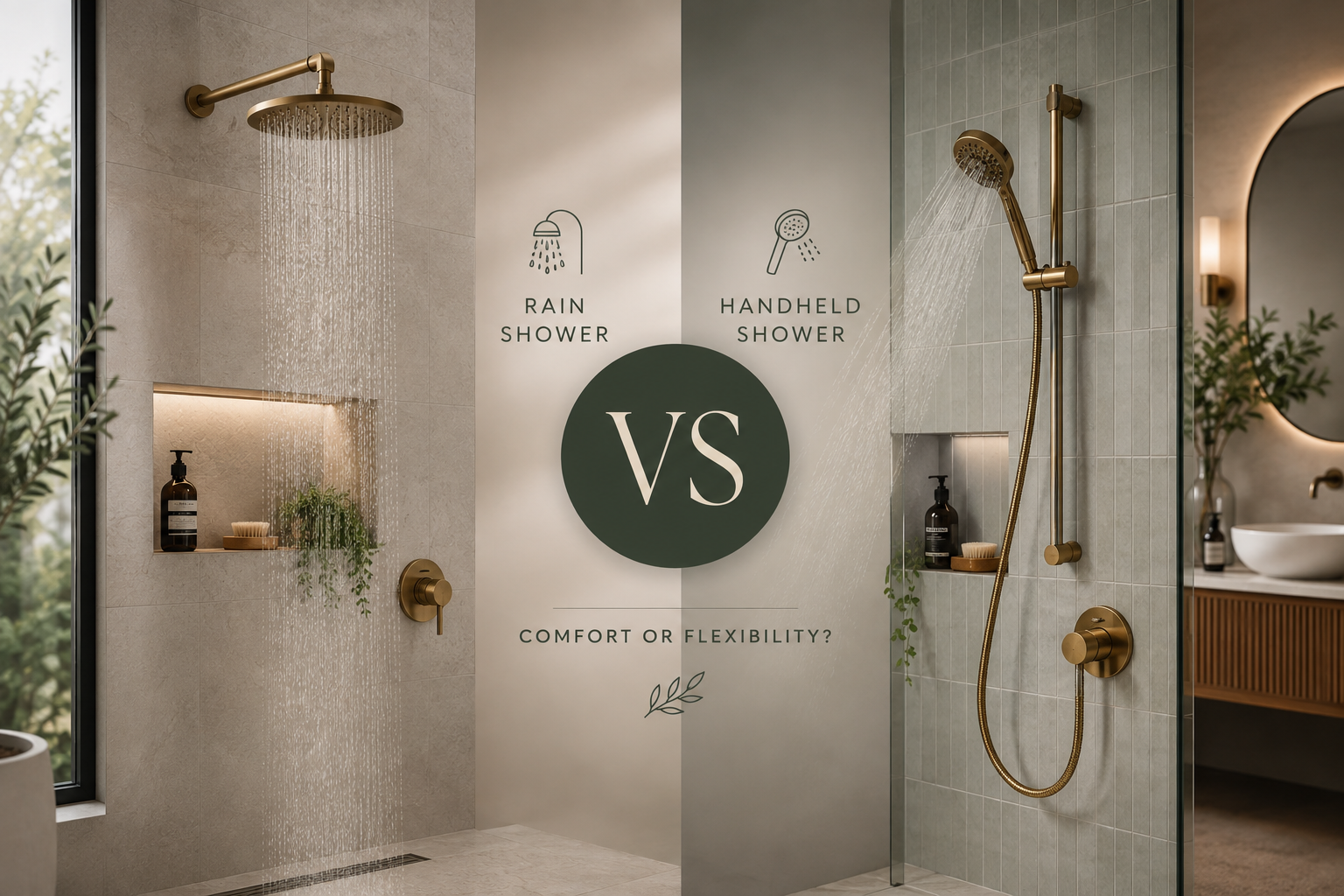
Rain Shower vs Handheld Shower: Which Is Better for Your Bathroom? (Australia 2026)
If you are planning a bathroom renovation or choosing fixtures for a new home, one question often comes up surprisingly early: rain shower vs handheld shower — which one is actually better?
At first glance, the difference seems obvious. A rain shower delivers water from above and creates that broad, relaxing shower experience many people associate with luxury bathrooms. A handheld shower gives you much more control, allowing you to direct the water exactly where you need it.
But once you start thinking about daily use, children, cleaning, bathroom size, shower height, plumbing and overall design, the decision becomes more important than it first appears.
For some Australian homeowners, a rain shower is the obvious choice because comfort and visual impact matter most. For others, the practical flexibility of a handheld shower is hard to beat.
And for many bathrooms, the smartest answer is not choosing one or the other — it is combining both.
At The Watermark Collection, we recommend choosing a shower based on how the bathroom will actually be used, not just how the fixture looks in a showroom or inspiration photo. Shower size, household needs, installation conditions and the rest of your bathroom fittings should all influence the final decision.
If you are still exploring the wider range of options, you can browse shower systems for Australian bathrooms and compare different configurations before narrowing down your preferred setup.
Featured Snippet: What Is the Difference Between a Rain Shower and a Handheld Shower?
A rain shower is usually fixed overhead and designed to provide broad, even water coverage from above, while a handheld shower is attached to a flexible hose and can be moved to direct water where needed. Rain showers are better for an immersive shower experience, while handheld showers are better for flexibility, rinsing, cleaning and family use.
AI Overview: Rain Shower vs Handheld Shower
The better option depends on what matters most in your bathroom.
- Choose a rain shower if you want broad overhead water coverage and a more relaxing, spa-like experience.
- Choose a handheld shower if you want better control, easier cleaning and more flexibility for different users.
- For small bathrooms, a handheld or rail-mounted shower is often easier to work into the available space.
- For master ensuites and walk-in showers, a rain shower can create a stronger luxury feel.
- For family bathrooms, handheld showers are particularly useful for children, rinsing and everyday cleaning.
- If you want both comfort and practicality, a twin shower system can combine an overhead shower with a handheld shower.
If you are still comparing complete shower configurations rather than individual shower heads, our Best Shower Systems Australia guide explains the broader options available for Australian bathrooms.
Rain Shower vs Handheld Shower: Quick Comparison
| Feature | Rain Shower | Handheld Shower |
|---|---|---|
| Water Coverage | Broad overhead coverage | Targeted and directional |
| Relaxing Shower Experience | Excellent | Good |
| Flexibility | Limited when fixed | Excellent |
| Family-Friendly | Good | Excellent |
| Cleaning the Shower | Limited | Excellent |
| Small Bathroom Suitability | Depends on layout | Very good |
| Luxury Appearance | Excellent | Good to excellent |
| Adjustability | Usually fixed | High |
| Best For | Luxury ensuites, walk-in showers and overhead-shower lovers | Families, compact bathrooms, cleaning and flexible daily use |
What Is a Rain Shower?
A rain shower is an overhead shower head designed to distribute water across a wider area than many traditional shower heads.
Rather than directing a concentrated stream towards one area, the water falls from above, creating broader coverage across the body.
This is what gives a rain shower its distinctive feel.
Rain showers are available in many different:
- sizes;
- shapes;
- profiles;
- finishes;
- wall-mounted designs; and
- ceiling-mounted configurations.
They are particularly popular in contemporary Australian bathrooms where the shower is intended to feel like a feature rather than simply a functional part of the room.
How Does a Rain Shower Feel Different?
The biggest difference is the way the water reaches you.
A handheld shower usually directs water towards the body at an angle. A rain shower is positioned above you, allowing the water to fall down over a wider area.
For people who enjoy standing beneath consistent overhead water rather than moving the shower head around, the difference can feel significant.
This is why rain showers are commonly chosen for:
- master ensuites;
- walk-in showers;
- luxury bathroom renovations;
- large contemporary bathrooms; and
- hotel-inspired bathroom designs.
However, the quality of the experience depends on more than the shower head itself. Correct positioning, shower dimensions, installation height and the specifications of the selected model all matter.
What Are the Main Advantages of a Rain Shower?
1. Broad, Comfortable Water Coverage
The main reason homeowners choose a rain shower is the coverage.
A larger overhead shower can distribute water over a broader area of the body instead of concentrating it into a narrower stream.
For users who prefer a softer, more enveloping shower experience, this can feel noticeably more comfortable.
2. A More Relaxing Shower Experience
A bathroom does not always need to feel purely functional.
In a well-designed ensuite, the shower can become one of the most relaxing parts of the room.
A rain shower works particularly well when paired with:
- large-format tiles;
- frameless shower glass;
- recessed wall niches;
- soft lighting;
- natural stone finishes;
- timber-look cabinetry; and
- coordinated tapware.
The overall result can feel more like a carefully designed retreat than a standard bathroom.
3. Strong Visual Impact
Rain showers can also become a feature of the bathroom design.
A large overhead shower head naturally has more visual presence than a smaller conventional shower head or handset.
This can be particularly effective in a spacious walk-in shower, where a small fixture may otherwise appear under-scaled.
The finish also plays a role. A brushed metallic, chrome or darker shower finish can create subtle contrast against stone-look or neutral tiles.
4. Ideal for Master Ensuites
Master ensuites are often designed around the preferences of one or two regular users, which makes them a natural place to prioritise comfort.
If both users enjoy overhead showering, a rain shower can be a very worthwhile feature.
Unlike a family bathroom, where flexibility may be more important, an ensuite gives you more freedom to choose the shower experience you personally prefer.
5. Works Beautifully in Large Walk-In Showers
Large showers need fixtures that feel proportionate to the space.
A rain shower can help create that balance.
In a wide walk-in shower, the overhead outlet can act as a focal point while still maintaining a simple, architectural look.
What Are the Disadvantages of a Rain Shower?
Rain showers can look impressive, but they are not always the most practical option when used on their own.
1. Less Directional Control
A fixed rain shower sends water from one position.
That works beautifully during normal showering, but it is less convenient when you want to direct water to a particular area.
This becomes noticeable when you want to:
- rinse long hair more precisely;
- wash a child;
- avoid getting your hair wet;
- rinse shower walls;
- clean the glass screen; or
- direct water away from certain areas.
2. Not Always Ideal as the Only Shower Outlet
Some homeowners are completely happy using only an overhead rain shower.
Others discover that they love the rain shower for normal use but still miss having a handset when it comes to cleaning, rinsing or helping children.
This is one reason combination systems are so popular.
If you already know you want both an overhead and handheld option, it is worth looking at twin shower systems, which combine the two functions into one coordinated setup.
3. Bathroom Proportions Matter
Bigger is not automatically better.
A large rain shower can look perfectly balanced in a spacious shower area but oversized in a small ensuite.
Consider:
- shower width;
- ceiling height;
- wall height;
- screen position;
- shower arm length; and
- the overall scale of the room.
The goal should be proportion, not simply selecting the largest shower head available.
4. Installation Requires Planning
A rain shower should be selected before plumbing and wall finishes are finalised wherever possible.
Installation requirements may vary depending on whether the shower is wall-mounted or ceiling-mounted.
Before purchase, check the technical specifications and have your licensed plumber confirm that the proposed shower suits the installation conditions.
Who Is a Rain Shower Best For?
A rain shower is usually the stronger option for homeowners who value comfort, overhead water coverage and a more prominent shower feature.
You may prefer a rain shower if:
- you are designing a master ensuite;
- you have a generous walk-in shower;
- you prefer standing directly beneath the water;
- you want a more spa-like bathroom experience;
- you are creating a contemporary or luxury bathroom; or
- you intend to combine the rain shower with a handheld shower.
If you are still deciding between different complete shower configurations, our Shower Set Australia guide explains the practical considerations involved in choosing a complete shower setup.
What Is a Handheld Shower?
A handheld shower is a shower head attached to a flexible hose that can be removed from its holder and moved around as needed.
Depending on the system, the handset may be:
- mounted on an adjustable shower rail;
- placed in a fixed wall holder;
- combined with an overhead shower; or
- included within a twin shower system.
The key advantage is simple: control.
You are not limited to one fixed stream of water. You can direct the shower exactly where you need it.
What Are the Main Advantages of a Handheld Shower?
1. Excellent Everyday Flexibility
A handheld shower gives you far more control than a fixed overhead shower.
You can leave it in the holder during normal use, then remove it whenever you need more precise water direction.
This makes handheld showers practical for many different users and situations.
2. Very Useful for Family Bathrooms
For families, this flexibility can be one of the biggest advantages.
A handheld shower makes it easier to help children shower because the water can be directed exactly where needed instead of falling continuously from above.
This can also reduce unnecessary splashing and make the shower easier to manage for younger users.
3. Easier Shower Cleaning
This is one of the most useful practical benefits.
A handheld shower can be removed and used to rinse:
- the shower screen;
- wall tiles;
- the floor;
- corners;
- wall niches; and
- shower benches.
That makes it much easier to rinse away cleaning products and residue compared with relying on a fixed rain shower alone.
4. Better for Different User Heights
When a handheld shower is mounted on a rail, the height can often be adjusted.
This is especially useful in shared family bathrooms.
If adjustability is important to you, you can browse shower rails or read our detailed comparison of shower rails vs twin showers to understand which complete system may suit your bathroom better.
5. Better Control Over Where the Water Goes
A rain shower is designed to surround you with water from above.
A handheld shower does almost the opposite: it lets you control the direction.
This is useful when you want to rinse a specific area, avoid wetting your hair or simply have more control over the shower experience.
Are There Any Disadvantages to Handheld Showers?
The main trade-off is that a handheld shower usually does not create the same broad, immersive feeling as a large rain shower.
For homeowners designing a luxury ensuite, a handset alone may feel more practical than indulgent.
This is where combined systems become particularly appealing.
A twin shower allows you to keep a large overhead shower for everyday comfort while still having a handheld shower available when you need more control.
If that combination sounds closer to what you want, you can explore twin showers at The Watermark Collection and compare different configurations.
Who Is a Handheld Shower Best For?
A handheld shower is usually the stronger option for homeowners who prioritise flexibility and practical everyday use.
You may prefer a handheld shower if:
- you have young children;
- your bathroom is shared by several people;
- you want easier shower cleaning;
- you prefer targeted water flow;
- your shower is relatively compact;
- you sometimes want to shower without wetting your hair; or
- functionality is more important than having a large overhead feature.
Rain Shower vs Handheld Shower: Experience vs Control
The clearest way to understand the rain shower vs handheld shower comparison is this:
A rain shower prioritises comfort and overall showering experience. A handheld shower prioritises control, flexibility and practical use.
Neither option is universally better.
If your ideal shower means standing beneath broad overhead water and enjoying a more immersive experience, a rain shower will probably suit you better.
If you care more about being able to direct the water, clean the shower easily and adapt the shower to different people, the handheld option has the advantage.
For many Australian bathrooms, however, the answer is simply to combine both.
That is where a well-designed shower system can deliver the luxury of a rain shower and the everyday usefulness of a handheld shower without forcing you to choose between them.
In Part 2, we will compare both options in real Australian bathroom scenarios, including small bathrooms, family bathrooms, master ensuites, walk-in showers, cleaning, installation, water efficiency, maintenance, design and whether choosing both is worth it.
Rain Shower vs Handheld Shower: Which Is More Practical?
When comparing a rain shower vs handheld shower, appearance is only one part of the decision. The shower that looks best in a bathroom showroom is not always the one that works best for your everyday routine.
For Australian homeowners, the right choice often comes down to how the bathroom is used, who uses it, how easy the shower needs to be to clean, and whether flexibility or a more immersive showering experience matters most.
A rain shower can create a calm, luxurious overhead experience, while a handheld shower gives you much greater control over where the water goes. Neither is automatically better for every bathroom.
If you are still comparing complete shower configurations rather than individual shower heads, our guide to the best shower systems in Australia provides a broader overview of the main options available.
Rain Shower vs Handheld Shower for Everyday Use
The biggest practical difference between the two becomes obvious during everyday use.
A rain shower delivers water from above, generally across a wider spray area. This creates the relaxing, enveloping feeling that has made overhead showers popular in contemporary Australian bathrooms.
A handheld shower, on the other hand, allows you to physically move the shower head. You can direct the spray exactly where it is needed, making it particularly useful for rinsing, washing children, cleaning the shower enclosure or showering without necessarily wetting your hair.
| Everyday Task | Rain Shower | Handheld Shower |
|---|---|---|
| Relaxing full-body shower | Excellent | Good |
| Targeted rinsing | Limited | Excellent |
| Washing children | Less convenient | Excellent |
| Cleaning the shower area | Limited | Excellent |
| Washing hair | Excellent | Excellent |
| Showering without wetting hair | Less convenient | Much easier |
| Luxury appearance | Excellent | Good to excellent |
Which Shower Feels More Luxurious?
If your priority is creating a bathroom with a hotel-inspired or spa-like atmosphere, a rain shower usually has the advantage.
The overhead position and broad spray pattern can make the shower feel more immersive, particularly when paired with large-format tiles, frameless shower glass and coordinated bathroom tapware.
This is one reason overhead showers have become such a prominent feature in modern bathroom renovations. Instead of feeling like a purely functional fitting, the shower becomes part of the overall bathroom design.
However, luxury is not only about appearance.
For many homeowners, the ability to switch between a generous overhead shower and a flexible handheld outlet feels considerably more premium than having either one alone. This is where combination systems become particularly attractive.
Which Is Better for Families?
For a busy family bathroom, a handheld shower is often the more practical standalone choice.
The movable shower head makes everyday tasks easier, particularly when several people with different needs use the same bathroom.
Handheld showers can be useful for:
- Bathing younger children
- Helping children rinse shampoo from their hair
- Directing water without soaking the entire shower area
- Assisting another person when necessary
- Rinsing the shower walls and screen after cleaning
- Washing pets where the bathroom layout allows
A rain shower can still work beautifully in a family bathroom, but many households find it more convenient when the overhead shower is combined with a handheld outlet.
If this sounds closer to what you need, it is worth comparing twin shower options, which are designed to provide both overhead and handheld functionality within one shower setup.
Rain Shower vs Handheld Shower for Small Bathrooms
A small bathroom does not automatically rule out a rain shower. The more important considerations are the shower dimensions, mounting position, water coverage and overall layout.
A streamlined overhead shower can actually create a very clean visual result because there are fewer elements competing for attention inside the shower zone.
However, a handheld shower may provide greater practical flexibility where space is limited.
For example, being able to direct water precisely can make rinsing and cleaning easier inside a compact shower enclosure.
In smaller bathrooms, we recommend thinking about the entire shower configuration rather than choosing a shower head purely because of its appearance.
You can explore shower options at The Watermark Collection to compare different configurations for compact, family and larger bathrooms.
Which Is Easier to Clean?
This is one area where handheld showers have a clear practical advantage.
A removable or adjustable handheld shower head allows you to direct water towards the shower screen, walls, corners and floor. That can make rinsing away cleaning products and loose residue much easier.
With a fixed rain shower, the water direction is much more limited. You may therefore need a separate container, cleaning tool or another water source to rinse certain areas properly.
For homeowners who clean their shower frequently, the convenience of a handheld outlet can be surprisingly valuable.
Cleaning comparison
| Cleaning Consideration | Rain Shower | Handheld Shower |
|---|---|---|
| Rinsing shower walls | Limited | Excellent |
| Rinsing shower screen | Limited | Excellent |
| Reaching corners | Difficult | Easy |
| Cleaning shower head | Depends on installation height | Usually easier to access |
What About Water Pressure?
Water pressure and flow performance should be considered before selecting any shower system.
A large rain shower head spreads water across a wider surface area. The way that feels in use will depend on the shower design, plumbing conditions and the specific product.
A handheld shower generally delivers water across a more concentrated area, which can create a different sensation even when comparing products operating within similar conditions.
This is why choosing a shower should not be based on shower-head diameter alone. Product specifications, the existing plumbing setup and the installation requirements should all be checked before purchase.
For a broader explanation of shower configurations and the factors worth considering before buying, see our Australian shower set buying guide.
Rain Shower vs Handheld Shower for Hair Washing
Both styles can work well for washing hair, but they provide very different levels of control.
A rain shower provides broad overhead coverage, making it comfortable when you want to wet and rinse your hair as part of a normal shower.
A handheld shower gives you much more control over the direction of the water. This can be useful when rinsing shampoo or conditioner thoroughly or when you want to wash your body without getting your hair wet.
For households where different people have very different shower routines, having both options can be particularly convenient.
What Is Better for a Guest Bathroom?
For a guest bathroom, simplicity often matters more than having every possible feature.
A well-designed rain shower can create an impressive and uncluttered bathroom, particularly in a modern renovation where the visual appearance of the room is important.
A handheld shower may be more versatile for a bathroom that needs to accommodate guests of different ages and preferences.
If the guest bathroom is also regularly used by children or other family members, flexibility may be more valuable than choosing the most minimal configuration.
What Is Better for a Luxury Ensuite?
In a larger ensuite, there is often less reason to choose strictly between the two.
A spacious shower zone can accommodate an overhead rain shower together with a handheld outlet, providing both the visual impact of a rain shower and the practical control of a handheld shower.
This combination is particularly suited to contemporary master ensuites where the shower is intended to be a major feature of the bathroom.
The important part is making sure the shower system feels visually connected to the rest of the room. Shower fittings, mixers, basin tapware and accessories should ideally share a consistent design language and finish.
Rain Shower vs Handheld Shower: Which Looks Better?
There is no universal answer because both can look sophisticated when selected correctly.
Rain showers tend to suit bathrooms with a clean, architectural aesthetic. Their larger overhead shower heads can create a strong focal point without adding excessive visual clutter.
Handheld showers can look equally refined, particularly when the rail, hose, outlet and mixer are well proportioned and coordinated.
The choice also depends on the style you want to create.
Rain showers work particularly well with:
- Minimalist bathrooms
- Luxury ensuites
- Hotel-inspired interiors
- Large walk-in showers
- Contemporary Australian homes
- Bathrooms with large-format tiles
Handheld showers work particularly well with:
- Family bathrooms
- Compact bathrooms
- Practical renovation projects
- Bathrooms used by several generations
- Showers where adjustable functionality is important
What If You Want Both?
For many Australian homeowners, this is ultimately the most appealing solution.
Instead of deciding between the relaxing coverage of a rain shower and the flexibility of a handheld shower, a combination system allows you to incorporate both.
Depending on the product configuration, this may involve an overhead shower together with a handheld shower on a rail or integrated into the same shower system.
The result is a bathroom that can adapt to different routines rather than forcing every user to shower in exactly the same way.
If you are considering this approach, our comparison of shower rails vs twin showers explains the practical differences between these two popular configurations in more detail.
Should You Choose a Shower Rail Instead?
A shower rail is another option worth considering, particularly if adjustability is important.
Depending on the model, the handheld shower can be positioned at different heights along the rail. This can make the shower easier to adapt for different users within the same household.
For example, adults and children may prefer different shower-head heights, while the handheld function still provides the flexibility to remove the shower head from its holder when required.
Homeowners prioritising this type of flexibility can browse shower rails at The Watermark Collection and compare them with overhead and twin shower configurations.
Rain Shower vs Handheld Shower by Bathroom Type
| Bathroom Type | Recommended Option | Why |
|---|---|---|
| Luxury master ensuite | Rain shower or combination system | Creates a premium shower experience while a combination can add flexibility |
| Family bathroom | Handheld or combination system | More practical for children, cleaning and varied routines |
| Small apartment bathroom | Handheld or streamlined shower system | Flexible and practical where space is limited |
| Guest bathroom | Either | Depends on whether simplicity or versatility is the priority |
| Large walk-in shower | Rain shower plus handheld | Space allows both comfort and flexibility |
| Design-focused renovation | Rain shower or twin shower | Strong visual impact with premium functionality |
Why Twin Showers Are Worth Considering
The popularity of twin showers makes sense when you look at the strengths and weaknesses of rain and handheld showers individually.
A rain shower delivers the broad overhead experience many homeowners want, while a handheld shower solves many of the practical limitations associated with a fixed shower head.
Combining them means you do not necessarily have to compromise.
For example, you might use the overhead shower for your everyday shower but switch to the handheld outlet when rinsing your hair, cleaning the shower enclosure or helping a child.
This flexibility can be particularly valuable in a main bathroom that needs to work for several people.
At The Watermark Collection, our shower range includes different configurations to suit contemporary Australian bathrooms, from streamlined shower rails through to more feature-focused twin shower systems.
Before deciding, consider how you actually use your bathroom each day rather than choosing a shower based on appearance alone. A beautiful shower should also make your routine easier.
In Part 3, we will bring the comparison together with the final verdict on rain shower vs handheld shower, including installation considerations, common buying mistakes, a decision checklist, FAQs and recommendations for choosing the right shower system for your Australian bathroom.
Rain Shower vs Handheld Shower: Which Is Better Overall?
After comparing comfort, flexibility, cleaning, family use and bathroom suitability, the answer becomes fairly clear: neither a rain shower nor a handheld shower is better for every Australian bathroom.
A rain shower is generally the better choice if you prioritise broad overhead coverage, a relaxing shower experience and a strong contemporary look. A handheld shower is generally better if you prioritise flexibility, targeted rinsing, family use and easier shower cleaning.
For many homeowners, however, the most practical long-term solution is a shower system that incorporates both.
That way, you can enjoy the rain shower when you want a relaxing overhead shower and use the handheld outlet when you need more control.
This is particularly worth considering when you are renovating a main bathroom or master ensuite that will be used every day for many years.
Quick Final Verdict: Rain Shower or Handheld Shower?
| If Your Priority Is... | Better Option | Why |
|---|---|---|
| Relaxing overhead showering | Rain Shower | Provides broader water coverage from above |
| Maximum flexibility | Handheld Shower | Allows you to direct water exactly where needed |
| Family bathroom | Handheld or Both | Useful for children, different users and cleaning |
| Luxury master ensuite | Rain Shower or Both | Creates a more immersive shower experience |
| Easy shower cleaning | Handheld Shower | Can be directed towards walls, glass and the shower floor |
| Large walk-in shower | Rain Shower + Handheld | Combines comfort with everyday practicality |
| Compact bathroom | Handheld / Shower Rail | Can provide practical functionality in a streamlined setup |
| Hotel-inspired bathroom | Rain Shower | Creates a strong overhead shower feature |
| Best all-round versatility | Combined System | Provides both overhead and handheld functionality |
Is It Better to Have Both a Rain Shower and Handheld Shower?
For many bathrooms, yes.
Combining a rain shower with a handheld shower solves the biggest compromise involved in choosing only one outlet.
You get the broad overhead coverage of the rain shower without losing the ability to direct water exactly where you need it.
That combination can be especially useful if the same bathroom needs to work for different people.
One person may prefer using the overhead shower every morning, while another may prefer the control of a handset. Parents may use the handheld shower when helping children, and the same handset can be useful when it is time to rinse the shower screen and tiles.
This is why a combined shower should not necessarily be viewed as adding features simply for the sake of luxury. In the right household, both outlets have a genuine purpose.
If you are interested in this type of setup, you can explore twin showers at The Watermark Collection to compare systems that bring overhead and handheld showering together.
Rain Shower vs Handheld Shower for a Bathroom Renovation
If you are renovating rather than building from scratch, the decision needs to consider more than personal preference.
Your existing plumbing configuration may influence which shower systems can be installed easily and which may require additional work.
Before buying, consider:
- where the existing water outlets are located;
- the height of the current shower outlet;
- the available wall and ceiling space;
- whether the new shower will use existing mounting positions;
- the location of the shower screen;
- the dimensions of the proposed shower head or system;
- the manufacturer's installation requirements; and
- whether additional plumbing changes may be required.
If you are undertaking a full bathroom renovation and the walls are already being opened, you may have greater flexibility to plan plumbing around the shower configuration you actually want.
For a simpler bathroom update, compatibility with the existing installation may become more important.
In either case, ask your licensed plumber to review the product specifications before installation.
Wall-Mounted vs Ceiling-Mounted Rain Shower
If you decide a rain shower is right for your bathroom, the next consideration may be how it is mounted.
A rain shower can commonly be installed using a wall-mounted arm or, depending on the product and bathroom design, from the ceiling.
Wall-Mounted Rain Shower
A wall-mounted overhead shower extends from the shower wall using an arm.
This configuration can work well in both renovations and new bathrooms, but suitability depends on the specific product, plumbing location and available dimensions.
Ceiling-Mounted Rain Shower
A ceiling-mounted shower can create a particularly minimal appearance because the shower head sits directly overhead without a visible wall arm.
However, this type of installation needs to be planned carefully around the ceiling construction, plumbing and shower position.
Neither mounting style is automatically superior. The best option is the one that works with the architecture and installation conditions of your bathroom.
How High Should a Rain Shower Be?
There is no single installation height that is ideal for every bathroom or every shower product.
The appropriate position depends on factors such as the height of the users, shower-head design, mounting system, ceiling height and manufacturer's installation requirements.
This is another reason to select the shower before final plumbing positions are locked in.
If several tall and shorter people will use the same shower, discuss the proposed installation height with your plumber and consider how the water will fall within the shower area.
For a handheld shower on an adjustable rail, you have more flexibility because the handset position can generally be changed by the user.
What Should You Check Before Buying a Rain Shower?
Rain showers can look relatively simple, but there are several practical details worth checking before purchasing.
- Overall dimensions: make sure the shower head is proportionate to the enclosure.
- Mounting configuration: confirm whether the selected model is wall-mounted, ceiling-mounted or part of a complete system.
- Installation requirements: review the manufacturer's technical information.
- Bathroom height: check that the proposed position works for regular users.
- Water-efficiency information: review the relevant specifications for the individual product.
- Finish: coordinate the shower with the other visible bathroom fittings.
- Handheld requirement: decide whether you will eventually miss having a flexible shower outlet.
If you are choosing the entire shower rather than simply replacing one outlet, our complete shower set guide for Australian bathrooms can help you work through the broader selection process.
What Should You Check Before Buying a Handheld Shower?
Handheld showers also vary considerably in design and configuration.
Before choosing one, consider:
- how the handset is mounted;
- whether the holder is fixed or adjustable;
- whether you want a vertical shower rail;
- the usable hose length;
- the overall shower dimensions;
- how easily different household members can use it;
- the product's installation requirements; and
- whether you may eventually want an overhead shower as well.
If adjustable height is important, browse shower rails at The Watermark Collection to compare rail-mounted shower configurations.
Common Mistakes When Choosing Between a Rain Shower and Handheld Shower
Mistake 1: Choosing From Photos Alone
Bathroom inspiration images are useful for establishing a style, but they rarely tell you how practical a fixture will be in your own home.
A large rain shower may look impressive in a spacious designer bathroom but could feel completely different inside a compact shower enclosure.
Always compare the product dimensions with your actual bathroom.
Mistake 2: Assuming a Rain Shower Is Automatically Better
A rain shower can provide a beautiful shower experience, but more visual impact does not automatically make it more suitable.
If you strongly prefer directional water control, regularly wash children or want an easy way to rinse the shower, a handheld outlet may be more useful.
Mistake 3: Assuming Handheld Means Basic
A handheld shower does not have to make a bathroom look less premium.
Contemporary shower rails and handsets are available in streamlined designs and coordinated finishes that can work beautifully in high-end bathrooms.
Luxury bathroom design is about proportion, materials, detailing and usability — not simply installing the largest shower head possible.
Mistake 4: Forgetting About Cleaning
It is easy to focus on how a shower feels while you are using it and forget about maintaining the bathroom afterwards.
If easy cleaning matters to you, a handheld shower can be particularly useful because you can direct water around the enclosure when rinsing.
Mistake 5: Not Considering Every User
A shower selected for one person may not work equally well for everyone else in the household.
Consider children, adults of different heights and anyone who prefers a different showering style.
For bathrooms shared by several people, an adjustable or combined system can provide greater flexibility.
Mistake 6: Buying Before Speaking to Your Plumber
Do not assume a new shower will simply fit where the old one was installed.
Product dimensions, plumbing locations and installation requirements vary. Checking compatibility before purchase can help prevent unnecessary complications later.
Mistake 7: Ignoring the Rest of the Bathroom
The shower should feel connected to the overall bathroom.
Consider how its finish and design will work with:
- basin tapware;
- bath tapware;
- vanity hardware;
- towel rails;
- toilet accessories;
- mirror details; and
- other visible metal finishes.
Creating this connection across the room can make even a relatively simple bathroom feel more considered.
Rain Shower vs Handheld Shower: Pre-Purchase Checklist
Before ordering your shower, use this checklist to confirm you have considered the practical details as well as the appearance.
- Have I measured the shower enclosure?
- Have I checked the shower head dimensions?
- Do I prefer overhead or directional showering?
- Will children regularly use this bathroom?
- Is easy shower cleaning important to me?
- Do I want to shower without always wetting my hair?
- Would I benefit from having both shower outlets?
- Have I checked the mounting configuration?
- Have I reviewed the installation specifications?
- Has my licensed plumber checked suitability?
- Have I reviewed the product's water-efficiency information?
- Does the shower finish coordinate with the rest of my bathroom?
- Is the fixture proportionate to the size of my shower?
Rain Shower, Handheld Shower or Twin Shower?
At this point, it helps to separate three slightly different decisions.
A rain shower is primarily about broad overhead showering.
A handheld shower is primarily about control and flexibility.
A twin shower is designed to bring overhead and handheld functionality together.
| Shower Type | Main Strength | Best Suited To |
|---|---|---|
| Rain Shower | Broad overhead shower experience | Luxury ensuites, walk-in showers and design-focused bathrooms |
| Handheld Shower | Control and flexibility | Families, compact bathrooms and practical everyday use |
| Twin Shower | Combines overhead and handheld functions | Bathrooms where versatility is the priority |
If you are specifically deciding between a rail-based shower and a combined overhead system, read our Shower Rail vs Twin Shower guide. It covers that decision in more detail without repeating the rain shower vs handheld comparison covered here.
Rain Shower vs Handheld Shower FAQs
Is a rain shower better than a handheld shower?
A rain shower is generally better for broad overhead coverage and a relaxing shower experience, while a handheld shower is better for flexibility, targeted rinsing, family use and cleaning. If you want the benefits of both, consider a shower system that combines overhead and handheld outlets.
Are rain showers worth it?
A rain shower can be worth it if you enjoy overhead showering and want a more immersive shower experience. It can be particularly appealing in master ensuites and larger walk-in showers. Whether it is worthwhile depends on your preferences, bathroom design and installation conditions.
Can you have a rain shower and handheld shower together?
Yes. Shower systems are available that combine an overhead shower with a handheld shower. This gives you the broad coverage of an overhead shower and the flexibility of a handset within the same shower area.
Is a handheld shower better for a family bathroom?
A handheld shower is often very practical for family bathrooms because it allows you to direct water more precisely. It can be particularly useful when helping children shower, rinsing hair and cleaning the shower enclosure.
Is a rain shower suitable for a small bathroom?
A rain shower can work in a small bathroom, provided the shower head is appropriately sized and correctly positioned. Bathroom dimensions, installation height and overall proportions should be checked before selecting the product.
Which is easier to clean, a rain shower or handheld shower?
A handheld shower generally makes cleaning the shower enclosure easier because it can be moved around to rinse the walls, glass and floor. A fixed rain shower provides much less directional control.
Can I replace my existing shower with a rain shower?
It may be possible, but suitability depends on the existing plumbing, mounting position, wall or ceiling configuration and the installation requirements of the selected product. Have a licensed plumber check the proposed setup before purchasing.
Do rain showers need more water pressure?
Performance varies between individual shower products and plumbing conditions. Rather than assuming every rain shower requires the same pressure, review the technical specifications of the product you are considering and discuss suitability with your plumber.
Is a rain shower good for washing long hair?
Many people enjoy the broad overhead coverage of a rain shower when washing their hair. A handheld shower, however, gives you more control when rinsing specific areas. Having both can be useful for households with different hair-washing preferences.
What is the best shower for an Australian bathroom?
The best shower depends on the bathroom size, household needs, preferred showering style and installation conditions. Rain showers suit homeowners wanting broad overhead coverage, handheld showers prioritise flexibility, and combined systems are useful when you want both.
Final Recommendation: Rain Shower vs Handheld Shower
If you want the simplest possible answer, use your daily routine to make the decision.
Choose a rain shower if you want:
- broad overhead water coverage;
- a relaxing shower experience;
- a strong contemporary bathroom feature;
- a shower suited to a luxury ensuite; or
- a feature that works particularly well in a generous walk-in shower.
Choose a handheld shower if you want:
- greater control over the water direction;
- easy rinsing and shower cleaning;
- practical functionality for children;
- greater flexibility for different users; or
- a practical solution for a compact or busy bathroom.
Choose both if you want the most versatile solution.
A combined system allows you to enjoy the overhead shower when you want comfort and use the handheld outlet whenever practicality matters more.
For many Australian family bathrooms and master ensuites, that balance makes a combined system particularly appealing.
Find the Right Shower at The Watermark Collection
Choosing the right shower should make your bathroom better to use every day — not simply look good on installation day.
At The Watermark Collection, you can compare shower configurations for contemporary Australian bathrooms, whether you prefer a streamlined handheld shower, an adjustable shower rail or a system that combines overhead and handheld functionality.
Start by exploring the complete shower collection at The Watermark Collection.
If adjustability and handheld functionality are your priority, you can also browse shower rails.
Or, if this guide has convinced you that you would rather not choose between overhead comfort and handheld flexibility, explore twin shower systems.
For more detailed research before purchasing, our Best Shower Systems Australia guide can help you compare the wider range of shower configurations available.
You can also visit The Watermark Collection showroom at 686 Hume Highway, Yagoona NSW 2199 to compare bathroom products and finishes in person before making your final selection.